The Metropolitan Museum of Art: Fueling the Illicit Trade of Antiquities

The illicit trade for antiquities is thought to earn traffickers over a billion dollars annually. As Jason Felch and Ralph Frammolino describe in their investigative account Chasing Aphrodite: The Hunt for Looted Antiquities at the World’s Richest Museum, “the illicit antiquities trade brings together highly educated, Ph.D. Harvard-graduate curators…doing business in bank vaults with people in the criminal underground”. Giacomo Medici is arguably the most infamous antiquities smuggler. He ran a highly lucrative syndicate responsible for smuggling thousands of Greco-Roman artifacts and passing them on to the elite international art market. Medici’s group operated for nearly 40 years before he was finally arrested in 1997. Despite the appalling damage inflicted by the illicit trade on archaeological sites and artifacts, museums have been slow to alter their practices with respect to dealing with buying antiquities with questionable provenance. The negligence and greed of renowned museums in the west is apparent in the study of the Sarpedon Krater and the Terracotta Bell Krater, which were held by the Metropolitan Museum of Art in New York despite the museum being aware that both antiquities had been looted.

The Sarpedon Krater is one of the most valuable artifacts smuggled by Medici. The red figure wine vessel from the 5th century BCE bears the signature of the painter Euphronios, a famous ceramics artist of the ancient Mediterranean. It is the only complete example of a surviving vase painted by Euphronios and is considered one of the finest Greek vase artifacts in existence. Two scenes adorn the krater. On the obverse, an episode from the Trojan War illustrating Sarpedon, son of Zeus, as he is carried away by Hypnos and Thanatos, the Gods of sleep and death respectively. On the reverse of the krater, a contemporary scene of Athenian youths arming themselves for battle is depicted. Both scenes are shown in the same style allowing for one to easily imagine how the mythological qualities of the scene depicted on the obverse can apply to the contemporary scene.
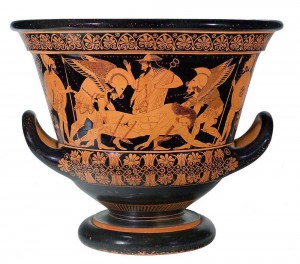
Image result for sarpedon krater

The Sarpedon Krater was shown to have been looted in December 1971 from a previously unknown Etruscan tomb in Cerveteri, Italy. Robert Hecht, an American antiquities dealer, sold the krater to the Metropolitan Museum of Art in 1972 for a record $1.2 million dollars. The director of the Met and primary negotiator in the purchase, Thomas Hoving, later said in his memoir, Making the Mummies Dance, “An intact red figured Greek vase of the early sixth century BCE could only have been found in Etruscan territory in Italy, by illegal excavators.” The Met knew the krater had been looted but went through with the purchase. It was not until 2006, after the trial of Medici, that the Met made an agreement with the Italian government to return the Sarpedon Krater to Italy in exchange for long-term loans of other artifacts.

The increased exposure when a leading curator, Marion True was indicted by a Roman Court in 2005 is considered by many as the turning point in cracking down on the illicit trade of antiquities. In the following years, many artifacts that were obtained illegally — including the infamous Getty Aphrodite — were returned to their country of origin from museums worldwide. But how serious were museums about changing their behavior long-term? Was this just a slap on the wrist or a truly paradigm shifting moment? The answer may not be clear yet, but it is interesting to examine how the Met has dealt with another antiquity demonstrated to have been looted in the years since.

A less expensive, yet interesting example is the case of the Terracotta Bell Krater. The vessel, used to mix wine and water, is vividly painted and depicts Dionysus, the god of wine and fertility, riding in a cart pulled by a satyr. The art has been attributed to the painter Python who lived in the city of Poseidonia in southern Italy. Similar to the Sarpedon Krater, this vase was originally looted from an Etruscan tomb in Italy in the 1970s. In 1989, the krater appeared at the auction house Sotheby’s, where it sold for $90,000. Soon thereafter, the vase became part of the Greco-Roman exhibit at the Met where it remained until recently. Just last year, the krater was taken off display and is now likely to be repatriated to Italy.

Image result for terracotta bell krater dionysus

The Terracotta Bell Krater of Dionysus may have never been uncovered as a looted antiquity had it not been for the work of Christos Tsirogiannis. The Greek forensic archaeologist works with the Association for Research Into Crimes Against Art and recognized the krater on display at the Met as one he saw in a picture taken by the smuggler Medici of a stolen antiquity. Once Tsirogiannis had confirmed the identity of the krater, he notified the Met, but received no response. No action appeared to be taken until Tsirogiannis contacted a New York prosecutor, which eventually issued a warrant in 2017 for the ancient vase. The museum quickly took the krater off display.

The Met was aware that the krater had been obtained from looters, however they were content to hang on to the artifact regardless. According to the Met’s acquisition policy, curators will investigate “whether the work of art appears in relevant databases of stolen works and the circumstances under which the work of art is being offered to the museum”. In the case of the Terracotta Bell Krater, this policy was clearly not followed. As Tsirogiannis says, “[museums] hang on to illicit objects as long as they can, until someone finds out… it’s all about money, fame, and ownership”. The Italian government was not interested in pursuing likely because the piece was not sufficiently high-profile. This calls in to question the motives of museums like the met and governments who support repatriation only when significant wealth and fame accompany the antiquity.

Despite 21st century improvements in holding museums accountable for dealing in illicit antiquities such as demonstrated by the indictment of Marion True, cases such as the Sarpedon Krater and the Terracotta Bell Krater illustrate that work remains to be done to prevent museums from continuing to fuel the looting and thievery of antiquities from archaeological sites. Tsirogiannis believes that, “as long as there’s a lucrative market for looted goods, for objects with uncertain provenance, there will be an illicit antiquities trade”. In an attempt to have the best exhibits, museums engage in a race to the bottom that in the long-run will hurt everyone. The process that museums take in dealing with looted Ancient Greek antiquities is of particular interest as it sets the precedent for the trade of illicit antiquities from other regions of the world.

The current civil war in Syria has led to mass looting of artifacts that range from as old as 10000 BCE to the Islamic period. The Islamic State in Syria (ISIS) continues to fund their terrorist motives by looting and dealing antiquities. Although this looting cannot be stopped, if museums and art dealers were more stringent in buying legally obtained artifacts the looting would certainly diminish. It is critical that museums show looters that the demand for illegal antiquities is drying up, and the benefits will be seen not just in the Mediterranean but globally too.

The actions of the Metropolitan Museum of Art with respect to the red figure Sarpedon Krater and Terracotta Bell Krater artifacts indicate that progress remains to be made in preventing museums from fueling the trade of illicit antiquities. Both kraters were looted from Etruscan tombs in Italy in the 1970s by the Medici ring. The Met turned a blind eye on the questionable provenance of the Sarpedon Krater, an implicit support of looting. Despite the international attention garnered by the case of the Getty Aphrodite and Marion True, it does not seem that the Met has completely reformed. When Tsirogiannis informed the museum that the Terracotta Bell Krater they had on display had been looted, the Met chose to ignore their responsibility. Not until legal means were taken did the Met choose to cooperate. Concerned researchers and archaeologists should not be tasked to make sure that illicit objects are returned to their rightful owners — instead, it is critical that influential museums and art dealers maintain integrity in their acquisitions and decisions to repatriate looted artifacts. Their decision does not just affect their galleries, but more importantly the preservation of archaeological sites around the world.


Works Cited

Felch, Jason and Ralph Frammolino (2011), Chasing Aphrodite: The Hunt for Looted Antiquities at the World’s Richest Museum. Boston and New York: Houghton Mifflin Harcourt, pp. 265–66, 312.

“Museum-Goers Beware: That Ancient Artifact May Be Stolen.” National Geographic News, 1 May 2017, https://news.nationalgeographic.com/2017/04/museum-artifacts-looting-christos-tsirogiannis-met/.

“Seven Reasons to Return the Elgin Marbles to Greece.” The Independent, 11 July 2016, http://www.independent.co.uk/voices/elgin-marbles-parthenon-sculptures-athens-greece-british-museum-a7129806.html.

“Warrant Issued For Ancient Vase.” The New York Times, The New York Times, 31 July 2017, www.nytimes.com/interactive/2017/07/31/arts/design/document-met-museum-warrant.html?rref=collection%2Fsectioncollection%2Fdesign&action=click&contentCollection

Why the Eligin Marbles Must Return to Athens

The marbles are some of the finest material culture artifacts in the world today. They were taken from Athens under Ottoman rule and the consequences of Ottoman decisions should not unnecessarily affect the Greek people. It is unclear whether the firman was ever obtained for the Marbles by Lord Eligin. Thus, the acquisition is akin to looting and the British now have a responsibility to return the marbles and right their wrongs. Reuniting all the marbles at their original home in Athens may allow scholars to learn more about their cultural significance that we cannot learn if they are apart.Image result for elgin marbles

The Athenians built the Parthenon, the original resting place of the marble statues, after defeating the Persians in the 50 year war. This was a victory for democracy, and the Parthenon celebrates democracy. Therefore, as a sign of support for democracy, the marbles should be returned to their original monument.

The Greek economy is currently in dire straits and they would benefit from having the Eligin Marbles as a tourist attraction. Tourism is already a mainstay of the Greek economy and if the marbles were returned they would certainly be a popular tourist destination.

For all these reasons the Eligin Marbles should be returned to their rightful home in Athens, where they can be viewed with the other marbles. The opportunity to see all of these statues in their original positions will be invaluable to the study and exposure of ancient Greek art.

Cyrene and Paestum

This week in class we learned about Cyrene and Paestum. These two cities were founded in the 7th century BCE and due to their geographic placement on the outskirts of the Greek world are rarely a focus of discussion when considering ancient Greek civilization. Paestum was a center for the development of Greek architecture, sculpture, and vase painting while Cyrene was a major economic power that emphasized the arts and literature.

Cyrene was located in modern day Libya and controlled many square miles of fertile farmland. The population was diverse, with a mixture of people from Thera, as well as Peloponnesians and Cretans. There was significant intermixing with the Libyans, and reforms in the 6th century gave Libyans some citizen rights. Cyrene’s strong economy was due to its agriculture. In the 4th century Cyrene sent emergency shipments of grain to mainland Greece in a time of famine, and this good deed was remembered for generations.

The story of the origin of Cyrene is really interesting as two general versions are told. The first attributes the settlement to the King Battos and his Theran followers while the other attributes the city’s foundation to the god Apollo. How do these two stories emphasize different characteristics of Greek politics?Image result for arkesilas cup

An artifact that particularly stood out to me this week during our reading was the Arkesilas Cup. This Lakonian drinking cup from circa 560 BCE shows King Arkesilas I seated under a canopy whilst supervising workers. Unlike in other Greek iconography, the king appears more merchant than warrior, therefore showing power in a different capacity. Additionally, African animals are depicted on the cup. I think it is really interesting how the Greeks thought of trade as between indlviduals, and therefore the iconography of the cup makes the personal connection of the trade with Cyrene clear. The Arkesilas Cup is fascinating as it blends Greek and African iconographies and illustrates the fascinating position that the melting pot of Cyrene occupied.

Ancient Greek Urban Planning

This week in class we learned about the Early Classical (480-440 BCE) period in Ancient Greece. Some of the characteristics of this epoch that stood out to me include the widespread urban planning, the rise in popularity of wall painting, and the construction of the Temple of Zeus at Olympia.

How does the notion of one step backwards, two steps forward apply to the urban planning and developments in architecture in ancient Greece? This week we read about the grid planning in the Sicilian town of Naxos. In 476 BCE, Hieron of Syracuse deported the citizens of the Sicilian town of Naxos so that he could rebuild it with a 1:4 ratio of block width against length. The theme of destruction as a segway to advancement has appeared throughout our study of ancient Greek civilization, why is it that significant societal changes so often come after devastation?

It is interesting to read about how the democratic ideology of the time played into the grid plan design, which has become the prevalent form of city planning. Each block contained four houses of equal size, with civic spaces interrupting the grid. The idea of an equal allotment for all was central to Athenian politics and it is fascinating that this early form of democracy continues to inform modern societies all over the globe.

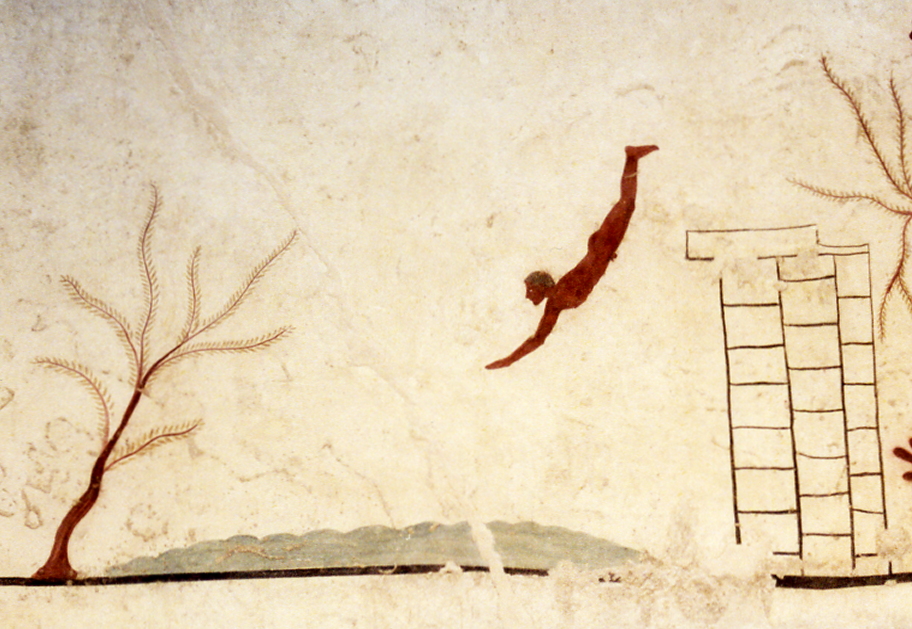
I enjoyed reading about the increased popularity of wall painting in the 5th century BCE. Many wall paintings deteriorated quickly and so little survives from Classical Greece. One exception is the Tomb of the Diver, which is estimated to have been built around 470 BCE in the city of Paestum. What stylistic elements may students of Greek art have missed that are not present in pottery but were essential to other forms of art that have not been as well preserved?

Image result for tomb of the diver

The monument is a grave made of five limestone slabs with each painted using a fresco technique. The slab covering the tomb depicts the scene that gives the site its name: a man is mid-dive off a stone ledge into a stream of water. Painted tombs were an Etruscan tradition and this tomb was likely inspired by Etruscan influence. Greek painting had always emphasized figures over their setting, and this scene of the diver is an exception, indicating that stylistic changes were afoot. I am curious as to what societal changes may have been motivating these stylistic preferences in art?

Stylistic changes in architecture also accompanied the 5th century in ancient Greece. The Temple of Zeus at Olympia was likely completed by 457 BCE when a golden shield was dedicated to commemorate a victory over the Athenians. The columns were built taller than in the Archaic period and the Doric capitals were straighter. The carving style of the marble sculptures that adored the pediments favored large masses over surface details. What similarities existed between the evolving architectural and sculptural styles and how did the developments of new techniques inspire these styles?

Sex and Money in Ancient Greece

Currency is something we take for granted in the modern world. Reading about the introduction of standardized coinage in Athens and discussing its ramifications in class has enticed my curiosity. In the workshop this week we debated the notion put forward by Neer that “coinage was not an economic necessity but a political one”. When the Greeks struck a vein of silver the democrat Themistokles convinced the people to spend the money on a navy. Large state expenditures were facilitated by the use of coinage. The naval policy allowed men of all socioeconomic levels to join the navy and fight on behalf of the city. This strengthened the democratic sentiment in Athens and illustrates how money was much more than solely an economic tool. These coins also provide an interesting way to stack stylistic changes throughout centuries. Athenian coins with the head of Athena on the front and the symbol of the goddess, the owl, on the back, persisted for the next several hundred years and provide an insight into the changing culture.

Image result for greek owl coins

The influence of coinage is also seen in the sexual relations common of the time. Only men were considered full citizens, and therefore female prostitution was legal. Homoerotic relations between adult men and minors were also common, and citizenship was also not an issue since minors had not yet reached age of becoming a citizen. Elite men at symposions would socialize with hetaira, educated females who would offer company and long-term sexual relations in exchange for gifts. The hetaira were an important part of the symposion and enjoyed an enviable and respected position of wealth. These women were generally treated to gifts rather than monetary compensation. In modern times we continue to see gift giving as the ultimate compensation.

The porne were the lower class prostitutes, who worked on the streets of mercantile centers in exchange for monetary compensation. These women had numerous and anonymous clients. I was curious to know whether the porne and hetaira was truly a binary distinction and whether any mobility between ranks could exist? Leslie Kurke notes that many women of uncertain status played a role in the symposion including flute girls, acrobats, and dancers. Evidence suggests these women also provided sexual services, which flies in the face of the porne-hetaira distinction. As Kurke notes, the distinction maps the difference between gift and commodity onto sexual relations of the time.

The red-figure pottery of the time began to experiment with the use of space. Many of these vessels were made for symposions, where complexity and double meanings were encouraged. Artists took risks that previously may have not been taken. I found it interesting how their “comedy” is in some cases transferrable to modern times, while other jokes fall flat on our ears.

Olympics Transcend Sport

The role of sport on the modern political and social atmosphere is immense, both on the national and global level. It is fascinating reading about the role that competitive sport had in ancient Greece. The first Olympic games can be traced back to the 8th century BCE. They were held every four years in the city of Olympia and included equestrian events, foot races, wrestling, and boxing. The games brought together elites from all around Greece, as Neer states “tyrants and aristocrats of all political persuasions made their offerings and jockeyed for position”. Olympia was an ideal place to host these competitions as it stood outside of the control of any strong state.

Similarly to modern times, winning an Olympic competition brought great fame, status, and potential wealth back home. Many tyrants and leaders of Greek colonial expeditions were previous Olympic champions. The custom arose that the returning champion would dedicate his crown on the altar of the city’s deity. The term “crowning the city” may originate from this practice. It “made the glory of victory communal” according to Neer. The city would in return give the victor public honors, such as dedicate a statue.  Screen Shot 2018-11-02 at 4.30.02 PM.png

The story of the Athenian tyrant Peisistratos and his rival Kimon stood out to me for the parallels to the modern day Olympic games. Peisistratos’ horses lost two olympics running to Kimon’s horses in the chariot race. Peisistratos was furious, and demanded that Kimon hand over the victory. By the next Olympiad, Peisistratos had murdered Kimon. This irrational desire to be champion in sport is something we still see today. The Russian doping scandal illustrates that some countries are willing to blur the line to win Olympic medals and claim to have the most superior athletes.

This was a time of opulent investment in religious shrines. where each city and its citizens left offerings for their respective deity. At Olympia, Zeus was the most important deity, and this site was special as it was “panhellenic”, in an extended sense belonging not just to the city, but to all Greeks. Each Olympic champion was allowed to erect a statue of themselves in the Altis, the sanctuary precinct. The first of these were made from wood but bronze quickly became the most popular medium. Olympia is also the origin of many terracotta sculptures. Many of these were likely made to decorate the treasure houses.

-Conor


Lessons from Kouros and Kore

This week in class we focused on the kouros and kore sculptures in 6th century BCE Greece. The use of grids and proportional systems made the sculptures rather formulaic. Almost no attention was spent on individualized features. Instead, these stone items were generic representations of the panhellenic elite. Neer comments that “public and private collided in the medium of sculpture”. I found this notion really fascinating, and I’d like to take some time to unpack some of the implications of this idea. How does the fact that kouros and kore never depict individuals, and instead the general idealized male & female bodies, act as evidence for the citizen state ideology proposed by James Whitley?

According to Neer, the kouros bears no weapons and wears no armor. It would have been perfectly plausible to make hoplite statues, yet these are not found. This tells us something about the meaning of the kouros and the priorities of the ancient Greeks. Croesus died in hoplite warfare, however the kouros found in his tomb is just like all the others. Neer quotes the Trojan king Priam, “for a young man all is decorous when he is cut down in battle and torn with the sharp bronze, and lies there dead, and though dead still all that shows about his is beautiful”. The kouros signifies that a man who falls in battle remains forever young, and it’s generalized figure implies the importance of civic duty in the lives of the ancient Greeks. The female korai showcase the strict gender roles in ancient Greece. They depict richly clothed, prettified women. While the kouros show men standing alone with nothing in hand, the korai often would be holding an offering, such as flowers.

Another strange contention of the private and public influence on the kouros was that despite always being on public display, they were generally privately funded and were a display of wealth and power by certain people and families. This shows the tug-of-war between the elites and political centralization.

In the reading this week the Lakonian iconography particularly stood out to me. Spartan bronze statues marked gender differently than the rest of ancient Greece. Some Spartan female figurines depict athletic victories by girls, often wearing short tunics, like shown in this likely Lakonian figurine found in Northwest Greece.

It was unusual for girls to participate in sport and to wear clothing exposing their thighs. Neer argues that these bronze statues were likely for local festivities celebrating girls’ rite of passage. In this celebration the social roles were inverted, allowing for their participation in classically male behavior. Kouros depict the idealized male and preservation of youthful beauty, so do these lakonian bronze statues illustrate a woman free from the constraints of gender roles as the idealized woman?

-Conor

Citizenship in Ancient Greece

A topic of discussion this week in class was the relationship between state-formation and urbanization. In his book titled The Archaeology of Ancient Greece James Whitney notes that “urbanism requires craft specialization; an increasingly differentiated economic system requires a hierarchy of decision making, that is administration… a hierarchy of decision-makers; hence states arise”. However, he concedes that the relationship is not always so simple. The term city-state is misleading. Many polis were in fact rural, however this did not constrain the development of an ideology of citizenship. Thus, Whitney proposes the term “citizen-state”, as a term that encompasses the state formation of Greece without its misidentification as the rise of “cities” as we know them today. This discussion makes me ponder the cultural influence of the “citizen-state ideology” described: how does the material culture of the 6th century Greece reflect changing principles such as emphasis on civic duties?

Chapter 5 in Neer provided fascinating images of Lakonian, Corinthian, and Attic pottery. Comparing and contrasting the artifacts from each region tells a story of competition and evolving culture. Depictions of symposion particularly grabbed my attention. The “eye-cups” as an ode to Dionysos, the god of wine, masks, and theatre seem to provide a multitude of services. The goblets were used for drinking wine, for their apotropaic qualities, and perhaps as a visual trick to provide drunken entertainment. To me, the symposion signals a civilized culture, where people could socialize, share ideas, and enjoy each others company in a way that perhaps could not exist in less refined societies.

222b-copie.jpg

Athens became the center of pottery by the middle of the 6th century. The decorations depicted Eastern influence such as incorporation of the sphinx, as well as Greek mythology and scenes from epic poems.  The Amasis Painter fashioned an amphora that juxtaposes the urban polis with the countryside. On one side Dionysos is seem confronting two mainads, wild women of the countryside, while on the other side is Poseidon and Athena, deities associated with the acropolis. This amphora makes me wonder how the Greeks reconciled urban and rural life? How did the social hierarchy reflect these perceived differences?

-Conor

Orientalizing or Colonizing?

The 7th century in the Mediterranean is often referred to as the “orientalizing” period. This era was defined by increasing Eastern influence on Greek society, population growth, and Greek migration throughout the region. This week in class we discussed whether this migration can and should be considered colonization. The framework presented by Peter Van Dommelen on colonization was applied to the story presented by Richard Neer, and several issues with his interpretation are apparent.

Neer paints a picture where Aristocrats became displeased with the centralization of power occurring in Greece and chose to pack up and move overseas. In his view, settlements were often therefore the product of individual initiative rather than state policy. Neer asserts that “migration does not express the imperial ambitions of Greek cities, but rather their inability to manage internal divisions, or to prevent citizens from leaving to form their own alternate communities”. Neer’s apologist view delegitimizes the suffering of the indigenous peoples displaced by the Greeks and whose cultures have been forgotten. By purposefully disregarding this side of the story, it seems to me that Neer buys into the dualist definition of colonization that is critiqued by Van Dommelen.

To a dualist, colonization is nothing but “a confrontation between two essentially distinct entities, each of which is internally homogenous and externally bounded”. The colonial culture invariably prevails over its “native” opponent, and therefore the partial representations of colonial situations can be attributed to this collision. The flourishing culture of the 7th century is a product of Greek colonization and the intermixing of Greek and indigenous traditions. Van Dommelen believes that “it is only when this essentialized view of culture is abandoned and attention shifted to what people do and how they conceive of the world and themselves, that the dynamics of colonial situations can be grasped”. How can we — as students of Greek Art and Archaeology — intellectually work to abandon this essentialized framework of culture to better understand Greek migration in the 7th century?

In class we read an excerpt from Book 9 of the Odyssey, Polyphemus the Cyclops, as an example of Greek portrayal of uninhabited land as ideal for settlement and the savage nature of the indigenous. Homer depicts the cyclops as “an overweening and lawless folk” whose plentiful harvest and livestock as a product of luck rather than aptitude. Odysseus blinds Polyphemus and escapes his cave using guile. Once escaped, Odysseus remarks that it was the lack of hospitality, or xenia, that caused the ill-fortune of the cyclops. The Greeks valued hospitality so dearly in this era as they were migrating far from home, and likely often relied on the kindness of others for their own well-being. The story of Polyphemus illustrates that the Greeks may have viewed the people whom they either displaced or assimilated as inferior, as they lacked what they perceived as civilized society.

I particularly enjoyed the discussion of the Chigi Vase by Neer. The protocorinthian jug illustrates the three stages of life for a Dorian male: boys would hunt hares in the countryside, youths hunted with spears and confronted prey directly, while men fought as hoplites. This vase depicts the Greek view of masculinity as well as portraying the importance of civic duties.

-Conor


Geometric Greece & Eastern Influence

This week in class we discussed the emergence of Geometric Greece (1100BCE-700BCE). Richard Neer poses the question: “how much cultural continuity existed from the Bronze Age to the Geometric Age?” The fall of the Mycenaean civilization wiped out approximately 75% of the Greek population, with many of the old sites being left abandoned or in ruins. Much of Mycenaean culture disappeared, such as their palaces and Linear B script. I wonder whether the Geometric Age would have followed a similar path if the fall of the Mycenaean civilization had not been so complete?

In either case, the end of the Bronze Age set the stage for the emergence of a new Greek civilization. Geometric Greece was influenced by contact with the Phoenicians in the near East. Greece developed city-states, or Polis, similar to those inhabited by the Phoenicians. Another critical point of influence was the Greek adaptation of the Phoenician alphabet. The transition from orality to literacy in ancient Greece set the stage for significant achievements. This transition has been a focal point in the study of Ancient Greek civilization. This week we read a few different perspectives considering the alphabetic writing of the Greeks and its consequence on their civilization. How did the emergence of literacy bias the work of archaeologists in understanding changing culture? The oral traditions that preceded literacy were both pragmatic but also a form of verbal art, and thus how was this orality transferred to literacy and what sacrifices in meaning were made?

I was particularly intrigued by Dr. Rosalind Thomas’ critique of the widely-held view that portrays ancient Greek alphabetic writing as the supreme form of writing and correlates this adoption with the intellectual achievements of the ancient Greeks. In Chapter 4 of Thomas’ Literacy and Orality in Ancient Greece she asserts that “sounds characteristic of one language may be heard very differently by speakers of another [language]”, and points out that the Greeks may have thought they were hearing vowel sounds when they were really hearing the Phoenicians guttural stops.

There is a faux equality constructed by ancient Greek historians between writing that directly mirrors speech and abstract thinking, which Thomas vehemently opposes. Thomas also notes that much of ancient Greece may not have been affected by literacy for several decades, thus contradicting the view that the alphabet created a consummate paradigm shift in all of Ancient Greece.

-Conor